Nutai, an industrial company that swapped gut feeling for data with Beetrics
Written by Víctor Ciudad-Fernández.
Nutai is an industrial solutions company. For a long time, leadership had a question that is hard to answer with data: how does the organization really work inside? The org chart shows who reports to whom on paper. The real work follows a different route, and that route never shows up in a box.
There were plenty of hunches. That some people were carrying more than their share. That a couple of areas barely spoke to each other. That there was talent nobody had quite spotted. The trouble with a hunch is that you cannot take it into a leadership meeting or turn it into a decision that survives a hard question.
The decision: stop guessing
Leadership brought in Beetrics for exactly that: to swap the gut feeling for a map. To see who really holds up the work and the team climate, even when none of that shows up in a job title or a contract.
The analysis: five minutes per employee, four dimensions
The analysis came out of a five-minute survey per employee, across four dimensions:
- Who people turn to when they have a problem.
- Who drives innovation.
- Who sustains the emotional climate of the team.
- Who really influences decision-making.
With those answers, Beetrics drew the company's real network: a picture of who depends on whom that the org chart never shows.
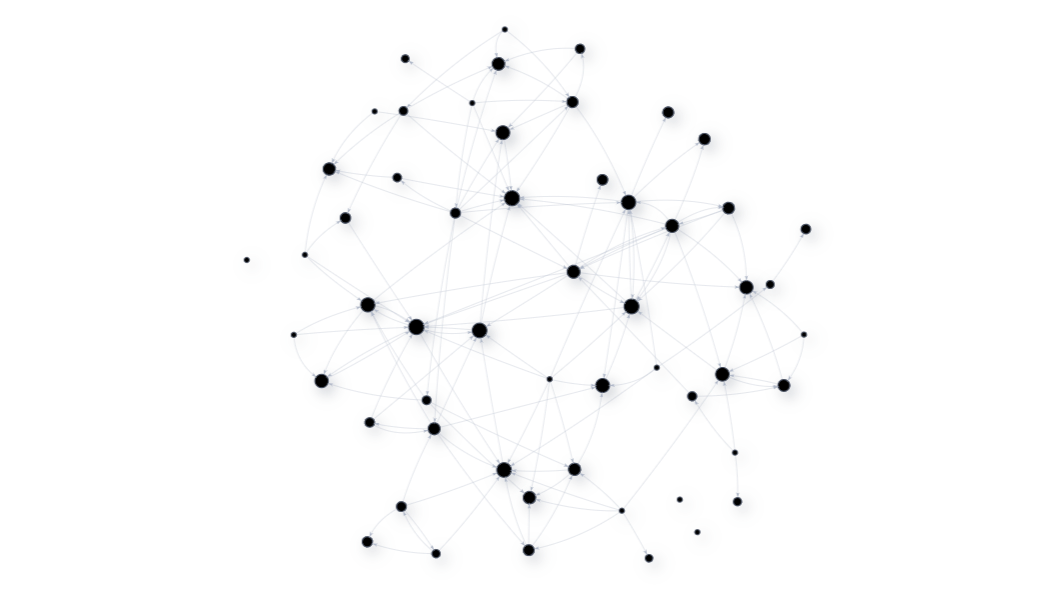
There is method behind the map, not hunches. The survey measures four validated dimensions (who people turn to with a problem, who drives innovation, who sustains the team climate and who influences decisions) with a scientifically reviewed instrument. The analysis is directed by Víctor Ciudad-Fernández, PhD from the University of Valencia. That is why the result is a blueprint of the organization, not a snapshot of opinions.
What appeared: an organization different from the PowerPoint
The picture didn't match the org chart. Five findings, to be precise.
6 key change agents
Six people acted as change agents. When they pushed in a direction, the team followed. Not because of their rank, but because of the real weight they carry inside the network.
2 critical bottlenecks
A disproportionate volume of work and decisions ran through two people. They were the company's bottlenecks, and that carries an uncomfortable reading: if either of them leaves, a large part of the organization is left without information and without the capacity to respond.
6 overloaded employees
Another six people were overloaded. Strong performers carrying more than anyone can hold for long. It is the kind of strain that makes no noise until it does: first performance slips and then, if nobody steps in, it ends in an exit nobody saw coming.
1 high-potential leader
A young employee with real leadership potential also surfaced. What flagged her was her influence in the network, not her tenure, which was short. Without a map like this she would have taken years to become visible, with the risk that she would leave before the company realized what it had.
1 organizational silo
And a silo. Two departments that matter to the business were running almost back to back, and every time a project forced them to work together, the company lost time, coordination and money that showed up on no report.
From findings to concrete decisions
Each finding turned into a decision. With the map in front of them, Nutai was able to:
- Protect the critical people, spreading their knowledge before a single point of failure could leave a team without operational capacity.
- Redistribute workload before any of the six overloaded profiles burned out.
- Connect the isolated departments with concrete interventions to break the silo.
- Plan the development of its next generation of leaders with data, not with hunches.
What used to be sentences like "I think so-and-so is at the limit" or "I get the feeling that young woman has potential" became information with names attached, metrics and a plan beside it.
What is at stake when a key person leaves
Nutai's two bottlenecks and six overloaded profiles are not an abstract problem: they are the people whose departure costs the most. Replacing a qualified profile or a middle manager runs on the order of half to one full year of their salary, once you add recruiting, the open vacancy, onboarding and the learning curve. For highly specialized profiles the figure climbs: Gallup puts the cost of an exit at up to twice the annual salary, and SHRM places it around six to nine months. We do not put a number on Nutai, because that figure is theirs. But the order of magnitude repeats in any industrial company.
If you want to put a number on your own turnover, we break the method down in the real cost of voluntary turnover.
Five minutes per employee to finally get an X-ray of how the people really work: who holds up whom, and where the risk sits.
Not a climate survey: the blueprint of the building
A climate survey measures how the workforce feels. The network map shows how it is held up: where the load-bearing columns are and where the cracks run. They measured the climate too, but what changed the decisions was the blueprint.
You can read the version published by Nutai on their site: At Nutai, innovation is also about people.
Want a real X-ray of your organization?
Request a demo